|
876 |
If ABCD are four points in a space, prove that

If ABCD are four points in a space, prove that
|
IIT 1987 |
|
|
877 |
If a, b, c are distinct positive numbers then the expression
( b + c – a ) ( c + a – b ) ( a + b – c ) –abc is a) Positive b) Negative c) Non–positive d) None of these
If a, b, c are distinct positive numbers then the expression
( b + c – a ) ( c + a – b ) ( a + b – c ) –abc is a) Positive b) Negative c) Non–positive d) None of these
|
IIT 1986 |
|
|
878 |
Let A and B be square matrices of equal degree, then which one is correct amongst the following a) A + B = B + A b) A + B = A – B c) A – B = B – A d) AB = BA
Let A and B be square matrices of equal degree, then which one is correct amongst the following a) A + B = B + A b) A + B = A – B c) A – B = B – A d) AB = BA
|
IIT 1995 |
|
|
879 |
The edges of a parallelepiped are of unit length and are parallel to non-coplanar unit vectors  such that such that 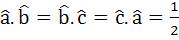 . Then the volume of the parallelepiped is . Then the volume of the parallelepiped is a)  b)  c)  d) 
The edges of a parallelepiped are of unit length and are parallel to non-coplanar unit vectors such that . Then the volume of the parallelepiped is a) b) c) d)
|
IIT 2008 |
|
|
880 |
If P =  , A = , A =  and Q = PAPT and Q = PAPT then PT (Q2005) P is equal to a)  b)  c) 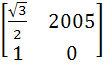 d) 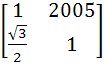
If P = , A = and Q = PAPT then PT (Q2005) P is equal to a) b) c) d)
|
IIT 2005 |
|
|
881 |
Consider three planes
P1 : x – y + z = 1 P2 : x + y – z = −1 P3 : x – 3y + 3z = 2 Let L1, L2, L3 be lines of intersection of planes P2 and P3, P3 and P1, and P1 and P2 respectively. Statement 1 – At least two of the lines L1, L2, L3 are non parallel Statement 2 – The three planes do not have a common point. a) Statement 1 is true. Statement 2 is true. Statement 2 is a correct explanation of statement 1. b) Statement 1 is true. Statement 2 is true. Statement 2 is not a correct explanation of statement 1. c) Statement 1 is true. Statement 2 is false. d) Statement 1 is false. Statement 2 is true.
Consider three planes
P1 : x – y + z = 1 P2 : x + y – z = −1 P3 : x – 3y + 3z = 2 Let L1, L2, L3 be lines of intersection of planes P2 and P3, P3 and P1, and P1 and P2 respectively. Statement 1 – At least two of the lines L1, L2, L3 are non parallel Statement 2 – The three planes do not have a common point. a) Statement 1 is true. Statement 2 is true. Statement 2 is a correct explanation of statement 1. b) Statement 1 is true. Statement 2 is true. Statement 2 is not a correct explanation of statement 1. c) Statement 1 is true. Statement 2 is false. d) Statement 1 is false. Statement 2 is true.
|
IIT 2008 |
|
|
882 |
Show that the system of equations
3x – y + 4z = 3
x + 2y − 3z = −2
6x + 5y + λz = −3
has at least one solution for any real number λ ≠ −5. Find the set of solutions if λ = −5 a)  b)  c)  d) 
Show that the system of equations
3x – y + 4z = 3
x + 2y − 3z = −2
6x + 5y + λz = −3
has at least one solution for any real number λ ≠ −5. Find the set of solutions if λ = −5 a) b) c) d)
|
IIT 1983 |
|
|
883 |
The solution of primitive equation
 is is  . If . If  and and  then then  is is a)  b) 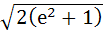 c) 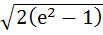 d) 
|
IIT 2005 |
|
|
884 |
If 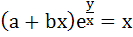 then prove that then prove that 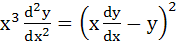
If then prove that
|
IIT 1983 |
|
|
885 |
If M is a 3 x 3 matrix where det (M) = 1 and MMT = I, then prove that det (M – I) = 0.
If M is a 3 x 3 matrix where det (M) = 1 and MMT = I, then prove that det (M – I) = 0.
|
IIT 2004 |
|
|
886 |
Let f(x) be defined for all x > 0 and be continuous. If f(x) satisfies 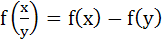 for all x, y and f(e)=1 then for all x, y and f(e)=1 then a) f(x) is bounded b) 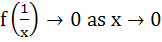 c) x f(x) → 1 as x → 0 d) f(x) = lnx
Let f(x) be defined for all x > 0 and be continuous. If f(x) satisfies for all x, y and f(e)=1 then a) f(x) is bounded b) c) x f(x) → 1 as x → 0 d) f(x) = lnx
|
IIT 1995 |
|
|
887 |
The number of values of x where the function  attains its maximum is attains its maximum is a) 0 b) 1 c) 2 d) infinite
The number of values of x where the function attains its maximum is a) 0 b) 1 c) 2 d) infinite
|
IIT 1998 |
|
|
888 |
The domain of the definition of the function y given by the equation 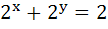 is is a) 0 < x < 1 b) 0 ≤ x ≤ 1 c)  ∞ < x ≤ 0 ∞ < x ≤ 0 d) ∞ < x ≤ 1
The domain of the definition of the function y given by the equation is a) 0 < x < 1 b) 0 ≤ x ≤ 1 c) ∞ < x ≤ 0 d) ∞ < x ≤ 1
|
IIT 2000 |
|
|
889 |
Solution of the differential equation is is
Solution of the differential equation is
|
IIT 2006 |
|
|
890 |
Let A =  If U1, U2, U3 are column matrices satisfying
AU1 =  , AU2 = , AU2 =  and AU3 = and AU3 =  and U is a 3 x 3 matrix whose columns are U1, U2, U3 then the value of [ 3 2 0 ] U  is is a)  b)  c)  d) 
Let A = If U1, U2, U3 are column matrices satisfying
AU1 = , AU2 = and AU3 = and U is a 3 x 3 matrix whose columns are U1, U2, U3 then the value of [ 3 2 0 ] U is a) b) c) d)
|
IIT 2006 |
|
|
891 |
Let f(x) =  , x ≠ , x ≠  then for what value of α, f(f(x)) = x then for what value of α, f(f(x)) = x a)  b)  c)  d)
Let f(x) = , x ≠ then for what value of α, f(f(x)) = x a) b) c) d)
|
IIT 2001 |
|
|
892 |
For any real t,  , ,  is a point on the hyperbola x2 – y2 = 1. Find the area bounded by the hyperbola and the line joining the centre to the points corresponding to t1 and –t1. is a point on the hyperbola x2 – y2 = 1. Find the area bounded by the hyperbola and the line joining the centre to the points corresponding to t1 and –t1.
For any real t, , is a point on the hyperbola x2 – y2 = 1. Find the area bounded by the hyperbola and the line joining the centre to the points corresponding to t1 and –t1.
|
IIT 1982 |
|
|
893 |
The integral is equal to a) b) c) d)
The integral is equal to a) b) c) d)
|
IIT 2014 |
|
|
894 |
X and Y are two sets and f : X → Y. If  then the true statement is then the true statement is a) 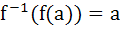 b)  c) ,  d) 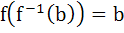
X and Y are two sets and f : X → Y. If then the true statement is a) b) c) , d)
|
IIT 2005 |
|
|
895 |
Let a and b are non-zero real numbers. Then the equation
(ax2 + by2 + c) (x2 – 5xy + 6y2) = 0 represents a) Four straight lines when c = 0 and a, b are of the same sign b) Two straight lines and a circle when a = b and c is of sign opposite to that of a. c) Two straight lines and a hyperbola when a and b are of the same sign d) A circle and an ellipse when a and b are of the same sign and c is of sign opposite to that of a.
Let a and b are non-zero real numbers. Then the equation
(ax2 + by2 + c) (x2 – 5xy + 6y2) = 0 represents a) Four straight lines when c = 0 and a, b are of the same sign b) Two straight lines and a circle when a = b and c is of sign opposite to that of a. c) Two straight lines and a hyperbola when a and b are of the same sign d) A circle and an ellipse when a and b are of the same sign and c is of sign opposite to that of a.
|
IIT 2008 |
|
|
896 |
Statement 1: The value of the integral is equal toStatement 2: a) Statement 1 is correct, statement 2 is correct. Statement 2 is correct explanation of statement 1 b) Statement 1 is correct, statement 2 is correct. Statement 2 is not a correct explanation of statement 1 c) Statement 1 is correct, statement 2 is false d) Statement 1 is incorrect, statement 2 is correct
Statement 1: The value of the integral is equal toStatement 2: a) Statement 1 is correct, statement 2 is correct. Statement 2 is correct explanation of statement 1 b) Statement 1 is correct, statement 2 is correct. Statement 2 is not a correct explanation of statement 1 c) Statement 1 is correct, statement 2 is false d) Statement 1 is incorrect, statement 2 is correct
|
IIT 2013 |
|
|
897 |
Multiple choices
If f(x) =  where [x] stands for the greatest integer function then where [x] stands for the greatest integer function then a)  b)  c)  d) 
Multiple choices
If f(x) = where [x] stands for the greatest integer function then a) b) c) d)
|
IIT 1991 |
|
|
898 |
A circle C of radius 1 is inscribed in an equilateral triangle PQR. The point of contacts of C with its sides PQ, QR and RP are D, E, F respectively. The line PQ is given by 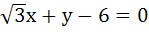 and the point D is and the point D is  . Further, it is given that the origin and the centre of C are on the same side of the line PQ. Points E and F are given by . Further, it is given that the origin and the centre of C are on the same side of the line PQ. Points E and F are given by a) 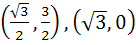 b) 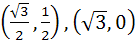 c) 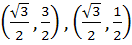 d) 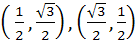
A circle C of radius 1 is inscribed in an equilateral triangle PQR. The point of contacts of C with its sides PQ, QR and RP are D, E, F respectively. The line PQ is given by and the point D is . Further, it is given that the origin and the centre of C are on the same side of the line PQ. Points E and F are given by a) b) c) d)
|
IIT 2008 |
|
|
899 |
One or more than one correct options If then a) b) c) d)
One or more than one correct options If then a) b) c) d)
|
IIT 2017 |
|
|
900 |
ConsiderL1: 2x + 3y + p – 3 = 0; L2: 2x + 3y + p + 3 = 0 where p is a real number and C : x2 + y2 + 6x – 10y + 30 = 0 Statement 1 – If the line L1 is a chord of the circle C then L2 is not always a diameter of C. Statement 2 - If the line L1 is a diameter of the circle C then L2 is not a chord of the circle.
Which of the following four statements is true? a) Statement 1 and 2 are true. Statement 2 is a correct explanation for statement 1. b) Statement 1 and 2 are true. Statement 2 is not a correct explanation for statement 1. c) Statement 1 is true. Statement 2 is false. d) Statement 1 is false. Statement 2 is true
ConsiderL1: 2x + 3y + p – 3 = 0; L2: 2x + 3y + p + 3 = 0 where p is a real number and C : x2 + y2 + 6x – 10y + 30 = 0 Statement 1 – If the line L1 is a chord of the circle C then L2 is not always a diameter of C. Statement 2 - If the line L1 is a diameter of the circle C then L2 is not a chord of the circle.
Which of the following four statements is true? a) Statement 1 and 2 are true. Statement 2 is a correct explanation for statement 1. b) Statement 1 and 2 are true. Statement 2 is not a correct explanation for statement 1. c) Statement 1 is true. Statement 2 is false. d) Statement 1 is false. Statement 2 is true
|
IIT 2008 |
|